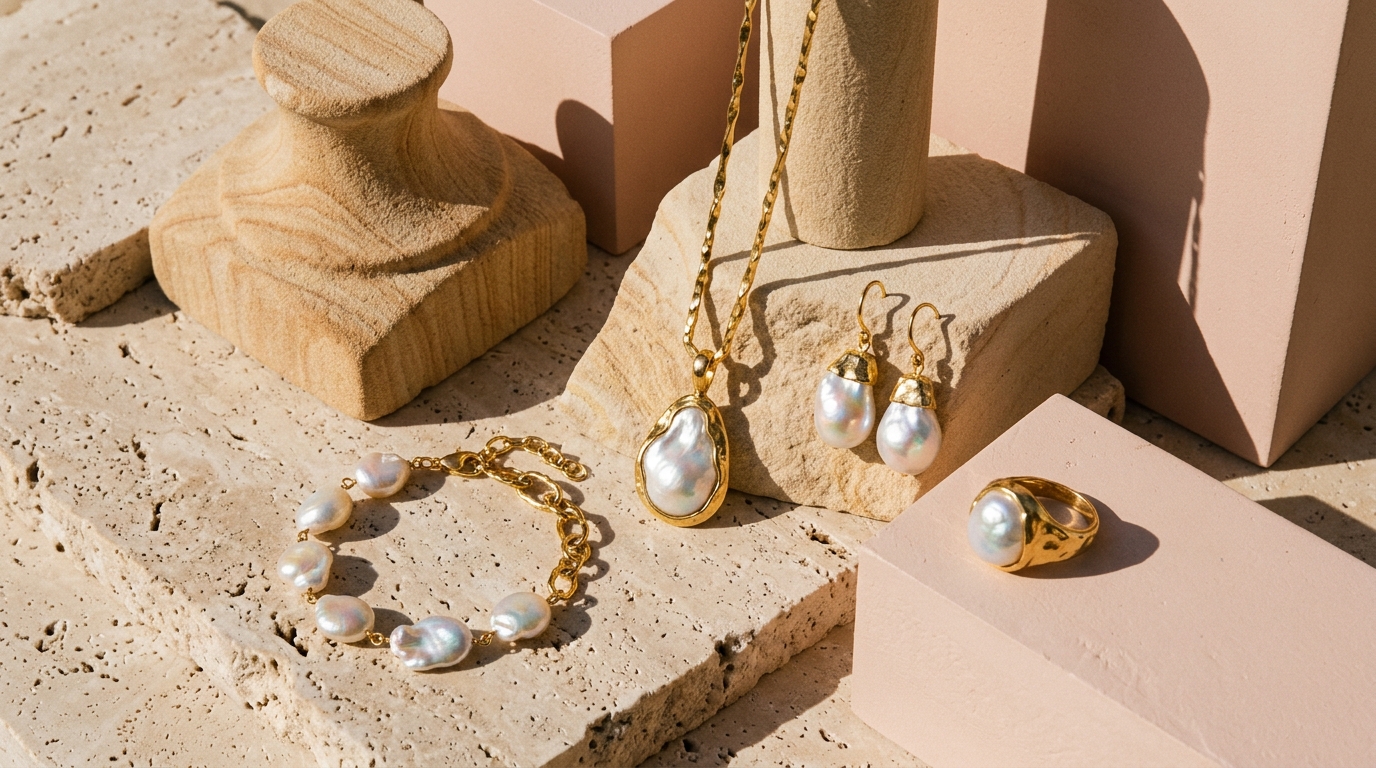
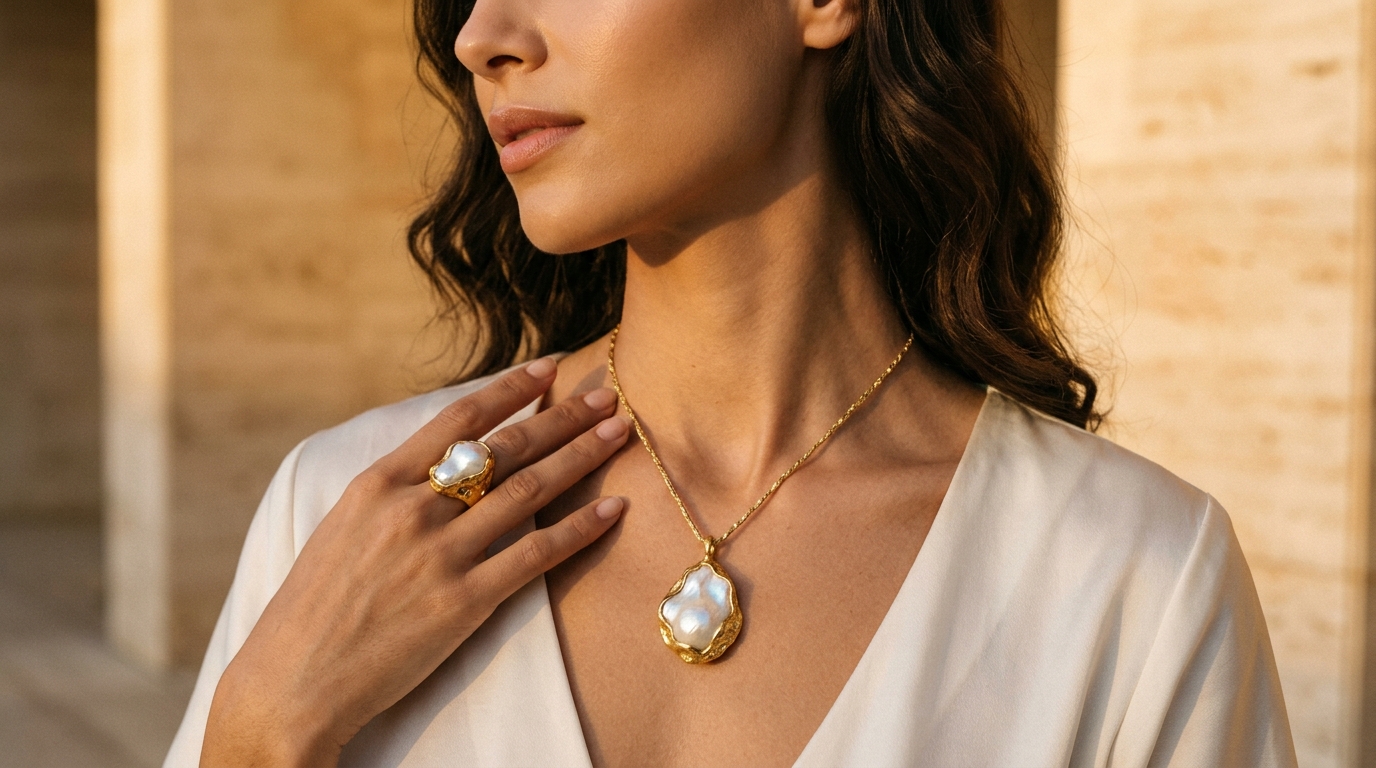
Fact-Checked & Updated on October 20, 2026 · Verified by the iBijoux Montréal Goldsmith & Gemological Atelier against International Gem Society (IGS) and GIA pearl grading criteria.
Baroque pearls are 100% authentic natural or cultured gemstones that form with asymmetrical, non-spherical silhouettes rather than uniform round shapes. Composed of microscopic aragonite calcium carbonate platelets bound by organic conchiolin (ranking 2.5 to 4.5 on the Mohs hardness scale), genuine baroque pearls are prized by modern fine jewelry collectors because their undulating surfaces refract ambient light into multidimensional rainbow iridescence—known gemologically as orient—ensuring that no two pieces on Earth are ever identical.
1. What Are Baroque Pearls? Etymology, Nacre Science & Orient
A baroque pearl is any natural or cultured pearl that departs from strict spherical symmetry, developing freeform contours, sculptural ridges, tear-drop curves, or elongated silhouettes. Historically derived from the Portuguese word barroco (meaning an “irregular or rough pearl”), the term later gave its name to the entire Baroque artistic era of the 17th century, when European royal courts prized giant asymmetrical pearls above faceted diamonds.
According to gemological documentation from the International Gem Society (IGS) and historical gemological archives on baroque pearls, over 90% of cultured freshwater pearls naturally exhibit some degree of baroque asymmetry because mantle-tissue nucleation allows the living mussel to deposit nacre organically over a 2-to-5-year growth cycle.
Unlike calibrated round pearls—which reflect light from a single uniform curve—the undulating surface topography of a baroque pearl acts as a series of natural micro-prisms. As light passes through translucent layers of hexagonal aragonite platelets, it diffracts into shifting overtones of champagne rose, peacock green, silver, and lavender. In our Meet the Baroque Pearl anatomy guide, we examine how this optical phenomenon (orient) makes high-luster baroque pearls appear lit from within.
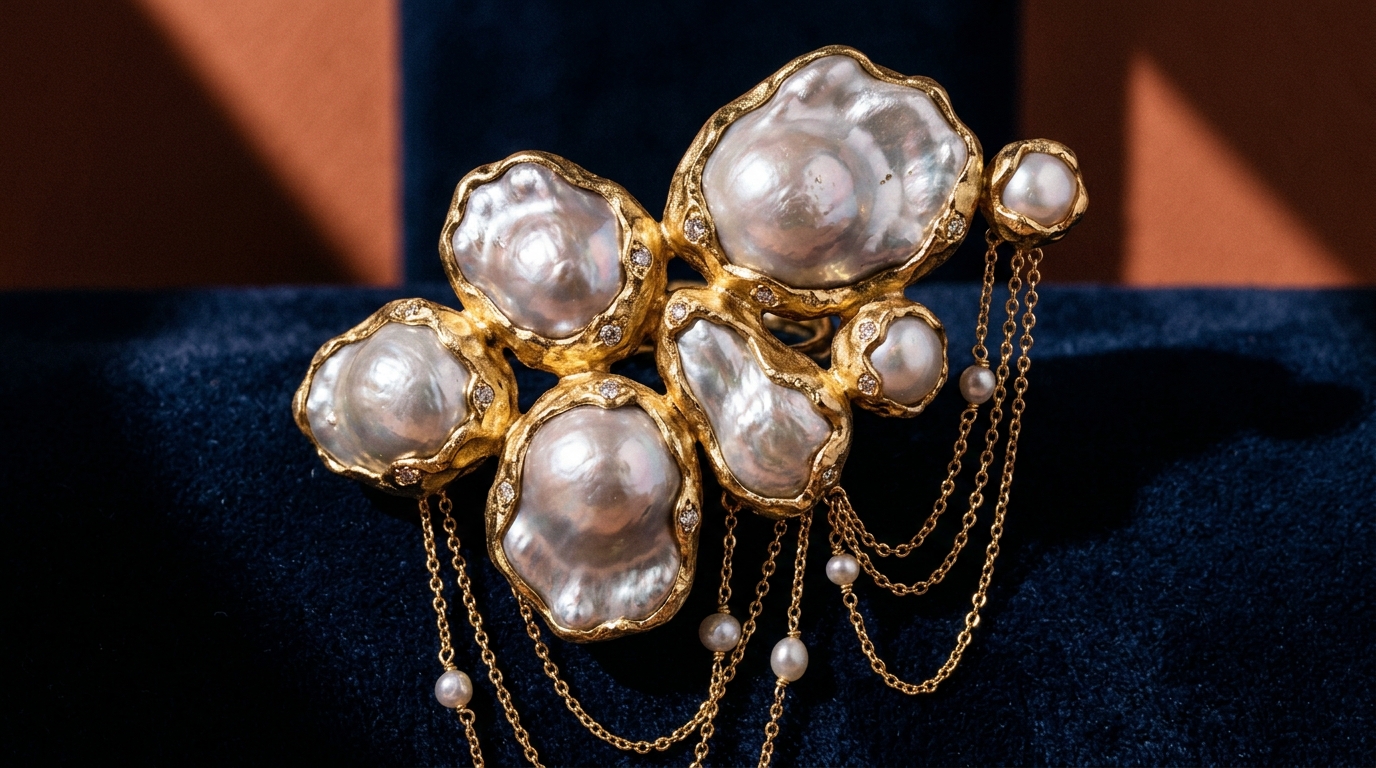
2. The 4 Signature Types of Baroque Pearls Compared (Edison, Biwa, Keshi & Coin)
Not all baroque pearls share the same internal structure, millimeter scale, or styling application. When selecting a piece of handcrafted pearl jewelry, understanding the four distinct varieties used in our Montréal studio helps you match the gem to how you wear your collection:
| Baroque Pearl Variety | Nucleation & Nacre Structure | Typical Size (mm) | Signature Silhouette & Optical Character | Best Jewelry Application | iBijoux Studio Price Range (CAD) |
|---|---|---|---|---|---|
| Edison Baroque Pearl | Single-bead nucleated (1 pearl per mollusk); thick crystalline nacre | 11 mm – 15 mm+ | Bold, sculptural organic volume with intense mirror-metallic lustre and deep rose/gold overtones | Solo focal pendants, collar anchors, and architectural rings | $36.95 – $47.99 CAD (e.g., Edison Baroque Necklace) |
| Biwa (Stick) Baroque Pearl | Mantle-tissue nucleated freshwater mussel pearl | 4 mm × 15–25 mm | Elongated, slender, twig-like crystalline bars that follow the curve of the wrist or collarbone | Gold-dipped slider bracelets, chokers, and linear drop earrings | $39.65 – $41.99 CAD (e.g., Biwa Slider Bracelet) |
| Keshi Baroque Pearl | Non-nucleated (100% solid pure nacre throughout) | 6 mm – 12 mm | Petal-thin, freeform organic flakes with the highest possible rainbow orient and surface shimmer | Lightweight sterling silver danglers and delicate stacking rings | $36.65 – $48.99 CAD (e.g., Keshi Dangle Earrings) |
| Coin & Organic Freeform | Flat-nucleated or tissue-nucleated freshwater pearl | 6 mm – 14 mm | Flat medallion discs or organic teardrops that sit flush against the skin without rolling | Everyday layering bracelets, station necklaces, and statement rings | $26.65 – $56.65 CAD (Sets up to $398.65 CAD) |
Edison Baroque Pearls: Saltwater Scale Meets Freshwater Durability
Introduced through advanced 21st-century cultivation techniques, Edison pearls are grown one pearl at a time inside genetically selected freshwater mussels rather than cultivating 20 to 30 smaller pearls in a single shell. This concentrated biological energy produces dramatic 11–15mm baroque forms that rival Australian South Sea pearls in presence while remaining accessible for everyday collection. Pieces like our Freshwater Edison Pearl Ring Necklace ($47.99 CAD) and Baroque Pearl Pendant Necklace ($39.65 CAD) showcase this unmistakable mirror-metallic glow.
Biwa Stick Pearls & 100% Solid-Nacre Keshi Pearls
First cultivated in Japan’s Lake Biwa, Biwa pearls are celebrated for their long, linear architecture. In our Old Montréal workshop, we hand-cap the tips of slender Biwa pearls in warm 14k gold-dipped finishes—a signature technique featured in the Baroque Biwa Pearl Choker ($39.65 CAD) and Freshwater Biwa Pearl Danglers ($41.99 CAD). Keshi pearls, by contrast, form when a mollusk rejects an implanted nucleus; because there is no bead center, a Keshi pearl is 100% solid nacre from core to surface, giving pieces like the Rainbow Baroque Pearl Thin Ring ($36.65 CAD) an almost liquid iridescence.
3. How to Tell Real Baroque Pearls from Fake Glass or Plastic Imitations
You can verify an authentic baroque pearl in under 30 seconds by testing its crystalline surface texture, thermal conductivity, and multi-layered optical depth. Because mass-market costume jewelry frequently uses molded plastic, resin, or glass beads coated in synthetic “essence d’orient” lacquer, our gemologists recommend four non-destructive authenticity tests:
- The Microscopic Grittiness Test: Gently glide two pearls (or the pearl and the edge of a fingernail) lightly across one another. Genuine nacre is built from overlapping microscopic aragonite tiles, creating a faint, sandy friction. Imitation glass or plastic pearls glide with a slick, soapy smoothness.
- The Thermal Touch Test: Hold the baroque pearl against the inside of your wrist after it has rested at room temperature. Real cultured pearls conduct heat slowly and feel noticeably cool for the first 3 to 5 seconds before warming to your skin, whereas hollow plastic imitations feel room-temperature immediately.
- The Drill-Hole & Growth-Line Inspection: Under 10x magnification, inspect the drill hole or mounting point. Authentic freshwater, Edison, and Keshi baroque pearls show crisp, solid nacre all the way into the drill channel, along with organic growth rings or pinpoint dimples. Fake beads often reveal peeling paint, air bubbles, or a chalky white glass core around the hole.
- The Weight & Silhouette Variance Check: Nature never duplicates a mold. In a pair of genuine Freeform Baroque Pearl Dangle Earrings ($39.65 CAD), the two pearls are hand-matched by our jewelers for visual harmony and millimeter weight, yet each retains its own distinct ridge pattern and light reflection.
4. The 5-Point Atelier Grading Standard: How Gemologists Evaluate Baroque Pearls
When evaluating baroque pearls, luster and nacre thickness account for over 70% of a gem’s visual value and heirloom longevity. Because traditional round-pearl symmetry grades (such as AAA spherical roundness) do not apply to freeform gems, gemological institutions evaluate baroque pearls using five specialized criteria. At the iBijoux Montréal atelier, fewer than 3% of harvested pearls pass our bench inspection:
The iBijoux Montréal 5-Point Baroque Pearl Inspection Checklist
- 1. Mirror Specular Luster: When held 15 cm under a daylight studio lamp, you should see a crisp, distinct reflection of the light source on the pearl’s convex ridges—never a dull, chalky, or milky glare.
- 2. Prismatic Orient Depth: Rotating the pearl by 30 degrees should reveal secondary rainbow overtones (champagne, rose, or silver-blue) floating beneath the surface.
- 3. Structural Nacre Integrity: Nacre layers must be dense and continuous (>0.8 mm on nucleated Edison pearls; 100% solid on tissue-nucleated and Keshi pearls), free from chalky spots or thin translucent patches that could chip over time.
- 4. Resting-Axis Ergonomics: A luxury baroque pearl must have a natural “resting face” so that when set into a pendant like our Luna Glow Baroque Pearl Pendant ($39.65 CAD), it lies flat and balanced against the collarbone rather than flipping backward.
- 5. Clean Focal Crown: While natural growth grooves are celebrated on baroque pearls, the primary upward-facing dome must be free of dark organic pits, cracks, or disfiguring calcified spots.
5. Styling Baroque Pearl Jewelry & Choosing Between 14k Gold-Dipped and 925 Sterling Silver
The secret to styling baroque pearls for modern everyday wear is deliberate textural contrast—pairing organic, undulating nacre against crisp architectural metal chains, tailored linen, or relaxed knitwear. Rather than matching an identical pearl necklace, bracelet, and earring set, contemporary collectors build dimension through graduated lengths and mixed metal warmth.
| Setting & Metallurgy Type | Visual Undertone Synergy | Hypoallergenic Profile | Ideal Wardrobe & Styling Match | Signature iBijoux Exemplars |
|---|---|---|---|---|
| 14k Gold-Dipped Settings & Molten Edges | Amplifies warm champagne, peach, and golden-rose pearl overtones; creates high-contrast sculptural edges | Nickel-free artisan brass or silver base with thick 14k gold electro-dipping | Warm skin undertones, camel coats, crisp white poplin, and stacked wrist cuffs | Organic Baroque Pearl Statement Ring ($45.65 CAD) & Gold Dipped Baroque Bracelet ($39.65 CAD) |
| 925 Sterling Silver Settings | Enhances cool icy-white, metallic silver, and lavender-blue orient reflections | 100% solid 925 sterling silver; ideal for sensitive pierced ears | Cool or neutral undertones, monochrome tailoring, charcoal cashmere, and bridal minimalism | Keshi Pearl Dangle Earrings ($39.65 CAD) & Sterling Silver Long Danglers ($36.65 CAD) |
For a complete three-tier collarbone stack, anchor your neckline at 16 inches with a structured baroque pearl necklace, add a delicate floating station chain like the Floating Pearl Station Necklace ($39.65 CAD) at 18 inches, and finish with asymmetric baroque pearl earrings or an adjustable band from our handcrafted pearl rings collection. (Read our companion dispatch, The Modern Art of the Stack, for detailed millimeter spacing rules.)
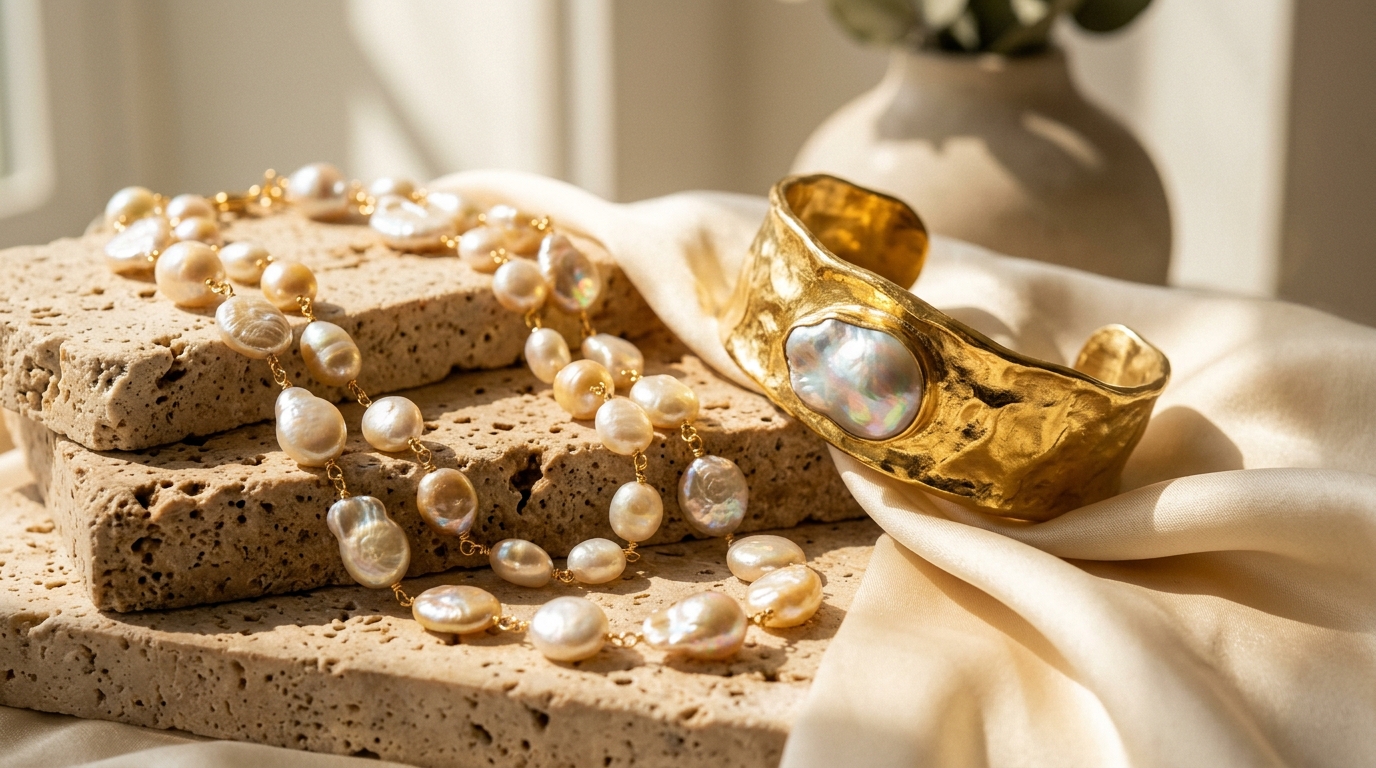
6. How to Care for, Clean & Store Baroque Pearls (Mohs 2.5–4.5 Protection)
Because all natural and cultured pearls rank 2.5 to 4.5 on the Mohs hardness scale and consist of calcium carbonate, they must be protected from both physical abrasion by harder metals and chemical etching by acids or alcohol. Following our four-step Montréal atelier care protocol preserves your pearl’s mirror luster for decades:
- Follow the “Last On, First Off” Rule: Always apply eau de parfum, hairspray, sunscreen, and glycolic or acidic skincare lotions at least 10 minutes before putting on your baroque pearl bracelets or necklaces. Alcohol and propellant acids chemically dissolve microscopic aragonite crystals, permanently clouding the nacre.
- Wipe After Every Wear: Before returning a piece to its box, wipe the pearl and its 14k gold-dipped or 925 sterling silver setting gently with a clean, lint-free microfiber cloth (barely dampened with pure lukewarm water if worn on a warm day) to remove natural perspiration.
- Never Use Ultrasonic, Steam, or Chemical Dips: Ultrasonic vibrations can shatter internal nacre layers or loosen artisan settings, and ammonia, vinegar, baking soda, or commercial silver dips will strip a pearl’s orient within seconds.
- Store Flat in a Breathable Velvet Pouch: Because pearls contain trace organic moisture (conchiolin), never seal them inside airtight plastic zip bags or hot, dry safe-deposit boxes where nacre can dehydrate and craze. Store each piece flat inside your signature iBijoux velvet keepsake box, separated from diamond prongs or heavy chains. Read our comprehensive atelier care guide, How to Care for Handcrafted Pearl Jewelry, or consult our Shipping, Returns & Care page.
7. Frequently Asked Questions About Baroque Pearls (FAQ)
Are baroque pearls real pearls?
Yes, baroque pearls are 100% real natural or cultured pearls formed inside living freshwater mussels or saltwater oysters. Unlike spherical pearls, their asymmetrical contours develop organically as layers of calcium carbonate nacre crystallize over 2 to 5 years, giving every genuine baroque pearl a one-of-a-kind silhouette and multi-layered rainbow iridescence.
Why are baroque pearls so popular in modern fine jewelry?
Baroque pearls are prized in contemporary fine jewelry because no two gems on Earth share the same shape or light reflection, offering sculptural individuality at a much more accessible price per millimeter than rare spherical pearls. At iBijoux Montréal, handcrafted baroque pearl necklaces, earrings, bracelets, and rings range from $26.65 CAD to $56.65 CAD for single pieces (and $398.65 CAD for multi-piece artisan sets).
What is the difference between Edison, Biwa, and Keshi baroque pearls?
Edison baroque pearls are single-bead nucleated (one pearl per mollusk) to achieve bold 11–15mm architectural volume and intense metallic luster. Biwa stick pearls are elongated, linear freshwater gems ideal for 14k gold-dipped bracelets and chokers, whereas Keshi pearls form without a nucleus and consist of 100% solid nacre with extraordinary surface orient.
How can you tell if a baroque pearl is real or fake?
A real baroque pearl feels cool to the touch for the first 3–5 seconds, exhibits subtle microscopic grittiness when gently rubbed against another pearl due to crystalline aragonite layers, and displays shifting rainbow overtones under angled light. Fake glass or plastic beads feel slick, warm quickly, and show uniform painted surfaces or flaking around the drill hole.
Can you wear baroque pearl jewelry every day or in the shower?
Yes, baroque pearls thrive on regular daytime wear because natural skin oils keep their organic conchiolin binder hydrated, but you should never wear them in the shower, swimming pool, or ocean. Because pearls rank 2.5 to 4.5 on the Mohs hardness scale, chlorine, hot water, shampoos, and perfumes will chemically etch the nacre and dull its luster.
How do you clean baroque pearls without damaging the nacre?
Wipe baroque pearls gently after each wear using a soft, clean microfiber cloth dampened only with lukewarm water, then let them air-dry flat before storing in a breathable velvet pouch. Never use ultrasonic cleaners, steam cleaners, toothbrushes, ammonia, or abrasive silver-polishing cloths directly on the pearl surface.
Where can I buy authentic handcrafted baroque pearl jewelry in Canada?
You can shop one-of-a-kind handcrafted baroque pearl jewelry directly from the iBijoux atelier in Montréal, Québec (ibijoux.ca/shop/). Every order is handcrafted to order and dispatches within 1–3 business days with complimentary tracked shipping across Canada and the United States on orders of $150 CAD or more ($12 CAD flat rate in Canada / $15 CAD to the USA under $150 CAD) and a 30-day return policy on unworn necklaces, bracelets, and rings.
MONTRÉAL ATELIER COLLECTION
Begin Your Baroque Pearl Collection
Explore 50+ handcrafted Edison, Biwa, Keshi, and coin baroque pearl creations—each sculpted to order in our Old Montréal studio with complimentary tracked shipping over $150 CAD.
Scope & Editorial Disclosure: The gemological data, Mohs hardness ratings (2.5–4.5), and care guidelines in this article apply specifically to untreated natural and cultured freshwater, Edison, Biwa, and Keshi baroque pearls as crafted by the iBijoux Montréal atelier. Dyed costume pearls, shell-core glass beads, or antique natural saltwater pearls mounted in historic closed-back settings may require specialized conservation. All Canadian Dollar (CAD) prices, shipping rates ($12 CAD in Canada / $15 CAD to the USA / Free over $150 CAD), and 30-day return terms were verified directly against live iBijoux store policies on October 20, 2026.